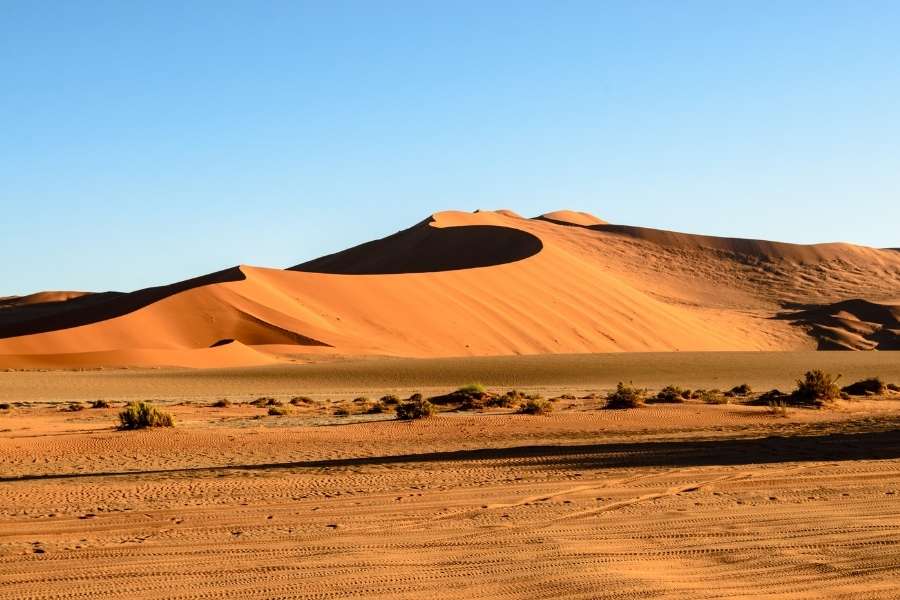
Deserts offer dynamic light and striking geometry. A breathtaking desert provides a vast canvas for your camera.
It is time to explore six incredible locations. Let us dive into these amazing travel spots.
Namib Desert, Namibia: Red Dunes and Ancient Trees
The Namib Desert features towering red sand dunes. Sossusvlei is famous for its high-contrast earth tones. Iron-oxidized sand shifts from orange to red during the day.
Exploring remote areas requires essential outback survival skills and desert navigation techniques to stay safe.
Nearby, Deadvlei shows dark camel thorn trees preserved for centuries. The trees stand on a white clay floor. Deep shadows align with sharp dune crests.
Early morning light creates crisp lines along every ridge. The contrast gives your photos incredible spatial depth.
+------------------+----------------------------------+--------------------------------------+
| Location Spot    | Key Visual Highlight             | Primary Technical Focus              |
+------------------+----------------------------------+--------------------------------------+
| Dune 45          | Sweeping curves & crest lines    | Shadow contrast during golden hour   |
| Deadvlei         | Ancient trees & white clay pan   | Wide-angle framing & ground textures |
| Big Daddy        | Massive scale & horizon views    | Telephoto isolation of dune ridges   |
+------------------+----------------------------------+--------------------------------------+
Lens Choices for Dune Landscapes
Choosing wide angle lens choices for vast desert landscapes helps frame dead trees with huge dunes behind them.
You can also use a telephoto lens. A longer focal length isolates delicate, wave-like sand textures.
This turns a vast scene into an abstract painting.
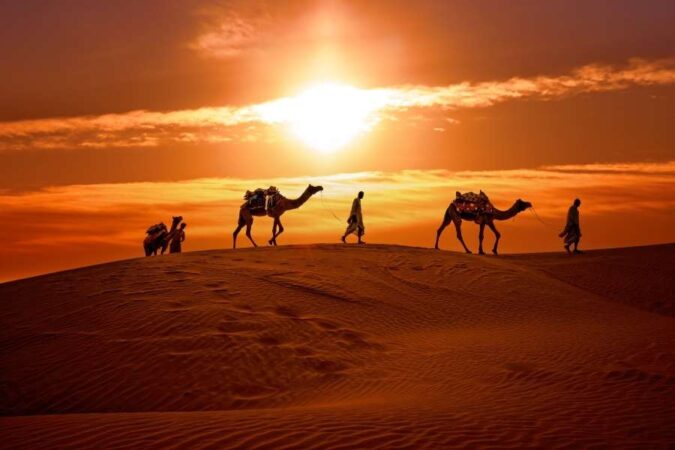
Wadi Rum, Jordan: Sandstone and Granite Gorges
Wadi Rum is a striking valley of red sand. Massive sandstone and granite rocks rise vertically from the ground.
Taking transformative desert trips that completely rewired how I think about travel often begins in quiet wilderness places like this.
This canyon landscape feels entirely otherworldly. Narrow gorges and stone arches create dramatic natural frames everywhere.
Sunlight moves quickly across the towering rock faces. Early morning light casts soft pink tones over the sand. Late afternoon turns the sandstone into burning amber walls.
+------------------+----------------------------------+--------------------------------------+
| Location Spot    | Key Visual Highlight             | Primary Technical Focus              |
+------------------+----------------------------------+--------------------------------------+
| Um Fruth Arch    | Natural elevated stone bridge    | Low-angle framing & scale contrast   |
| Khazali Canyon   | Narrow fissure with petroglyphs  | High dynamic range & shadow balance  |
| Burrah Canyon    | Long valley with sheer cliffs    | Golden hour side-lighting            |
+------------------+----------------------------------+--------------------------------------+
Finding Sunrise Views in Wadi Rum
Finding top scenic spots for sunrise photography in Wadi Rum requires an early 4×4 ride.
The sun breaks over the eastern mountains. Tall rock monoliths project long shadows across red sand.
Framing natural arches like Um Fruth creates deep perspective. Add a person or camel camp to show true scale.
Salar de Uyuni, Bolivia: The Vast Salt Flat
Salar de Uyuni is a remarkably photogenic locations choice in Bolivia. It spans over 10,000 square kilometers.
Perspective disappears on this flat white expanse. During the dry season, hexagonal salt crust patterns form.
The wet season brings a thin layer of water. This water transforms the flat ground into a huge mirror.
+------------------+----------------------------------+--------------------------------------+
| Season           | Visual Surface Condition         | Best Photographic Technique          |
+------------------+----------------------------------+--------------------------------------+
| Dry (May - Nov)  | Hexagonal salt crust patterns    | Low-angle forced perspective shots   |
| Wet (Dec - Apr)  | Flawless water mirror reflection | Symmetrical horizon framing at night |
+------------------+----------------------------------+--------------------------------------+
Capturing Sky Reflections
Sunsets turn the sky lavender, pink, and gold. These sunset vistas reflect clearly on the wet ground.
Night shooting reveals bright stars overhead. The Milky Way reflects right under your feet.
Atacama Desert, Chile: High-Altitude Arid Landscapes
Chile’s Atacama Desert is a high-altitude arid region. Low humidity and dark skies offer incredible clear views.
The geography ranges from salt mountain ranges to geyser fields. Turquoise lagoons sit beside white salt crusts.
Valle de la Luna features sharp stone ridges. Twilight turns distant snow-capped mountains purple against the ground.
Pro Tip: Cold nights at high altitudes drain camera batteries fast. Always pack extra batteries in your bag.
Protecting Gear from Fine Grit
Dust easily enters camera bodies during lens swaps. Learning how to protect camera gear from fine desert sand saves sensors.
Change lenses inside a sealed bag or vehicle. Use weather-sealed gear when strong winds blow dust around.
White Sands National Park, USA: Gypsum Sand Waves
White Sands National Park preserves a vast gypsum dunefield in New Mexico.
Gypsum sand looks bright white like snow. Unlike quartz sand, it stays cool under direct sun.
The rolling white dunes create clean minimalist compositions. The landscape changes appearance as light shifts.
+------------------+----------------------------------+--------------------------------------+
| Time of Day      | Lighting Condition               | Compositional Strategy               |
+------------------+----------------------------------+--------------------------------------+
| Late Afternoon   | Soft side-lighting               | Highlight dune ripple textures       |
| Blue Hour        | Cool pastel reflections          | Long exposure for calm sky tones     |
+------------------+----------------------------------+--------------------------------------+
Timing Your Dune Photoshoot
Knowing the best time of day to photograph sand dunes is crucial here.
Shoot during late afternoon or the blue hour. White sand reflects gentle pastel colors from the sky.
A polarizing filter manages bright glares. It increases contrast between blue skies and white crests.
Rub’ al Khali, UAE & Oman: The Massive Sand Sea
The Rub’ al Khali covers a massive desert expanse across the Arabian Peninsula.
Rolling dramatic dunes rise over 250 meters high. Reddish-orange sand stretches endlessly toward the distant horizon.
Strong desert winds reshape the dune crests continuously. Fine curtains of sand blow off sharp peaks.
+------------------+----------------------------------+--------------------------------------+
| Feature          | Environmental Challenge          | Recommended Equipment                |
+------------------+----------------------------------+--------------------------------------+
| Mega-Dunes       | Extreme heat & difficult walking | Carbon fiber tripod & light backpack |
| Sand Curtains    | High wind & blowing fine grit    | Protective rain/dust cover           |
| Desert Horizon   | Heat haze & thermal distortion   | Long telephoto lens (70-200mm)       |
+------------------+----------------------------------+--------------------------------------+
Golden Hour Shadow Work
Plan your shoot during golden hour for optimal light. Long shadows highlight every subtle surface contour.
Stand on a high ridge looking across alternating light bands.
A telephoto lens compresses distance between dune ridges. It emphasizes sweeping curves and wild isolation.
FAQ
What are the essential camera settings for photographing sand dunes?
Shoot in Aperture Priority or Manual mode. Use an aperture between f/8 and f/11. Set your camera to native base ISO 100. Use a fast shutter speed to freeze blowing sand. Use a tripod for low-light twilight shots.
How do I prevent my camera from overheating in hot desert environments?
Keep equipment inside shade when not in use. Wrap your bag in a light thermal blanket. If your camera gets hot, turn it off. Remove the battery and let it cool down gradually. Avoid placing hot gear right before cold air conditioning vents.
What is the best way to clean sand off camera gear after a shoot?
Never wipe sand directly off gear with a cloth. Quartz grains will scratch delicate surfaces. Use a rubber air blower on seams and glass first. Sweep away remaining grit using a soft brush. Finish with lens cleaning fluid on a microfiber cloth.
Which location will you visit first with your camera?
